Published post
Master Prompt for 8-Scene Cinematic AI Video Stories - Khmer Dialogue
Use this professional master prompt to create an 8-scene cinematic AI video where a food item becomes a living character inside the human body with Khmer and English dialogue.
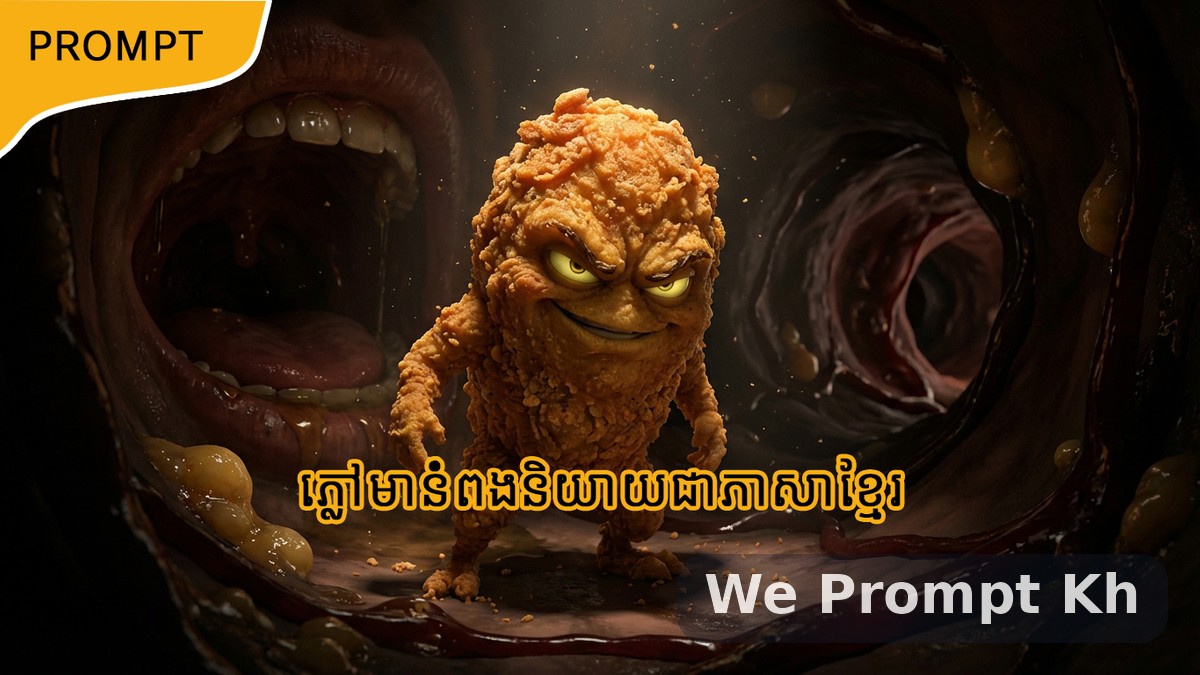
This master prompt is designed for creators who want to build emotional, cinematic, scroll-stopping short videos with AI. It transforms a common food item into a living character, places that character inside the human body, and guides the story through 8 connected scenes with strong visual direction and dialogue structure.
It is especially useful for short-form creators, AI filmmakers, prompt engineers, and content publishers who want a repeatable workflow for viral educational or warning-style videos.
Why this prompt is powerful
- It creates one consistent character across the full video.
- It builds a connected 8-scene story instead of random clips.
- It supports both positive and negative item storytelling.
- It includes Khmer dialogue output and English dialogue output.
- It is optimized for vertical 9:16 short-form content.
- It gives strong cinematic direction for lighting, camera, mood, and action.
What this prompt generates
- A first-step list of beneficial and harmful common items.
- A user selection step for choosing the main item.
- One master image prompt for the character design.
- An 8-scene video prompt with Khmer dialogue.
- An 8-scene video prompt with English dialogue.
How the workflow works
Step 1 — List generation
The prompt starts by generating two useful lists. The first list contains vegetables or beneficial items that help the body. The second list contains commonly consumed harmful items. This gives the viewer a clear starting point and makes the content interactive.
Step 2 — User selection
After the lists are shown, the user chooses one item. That selected item becomes the main character for the entire video story.
Step 3 — Visual and story generation
Once the item is selected, the prompt creates a full production structure. First it generates a detailed image prompt for the main character. Then it creates an 8-scene Khmer dialogue version, followed by an 8-scene English dialogue version with the same structure and actions.
Creative logic behind the prompt
The prompt automatically changes tone based on the selected item. A beneficial item becomes caring, protective, and helpful. A harmful item becomes deceptive, threatening, or destructive. This makes the result more emotional and more memorable for viewers.
The location also changes naturally across the story. The character may begin in the mouth, throat, or stomach, then move deeper through the digestive path, bloodstream, or internal organs. This creates a real sense of progression and narrative flow.
Best use cases
- AI-generated TikTok and YouTube Shorts content
- Educational health storytelling
- Khmer and English dual-language video production
- Viral prompt packs for creators
- Character-based food and body animation concepts
Copy-ready master prompt
MASTER PROMPT (PROFESSIONAL — 8-SCENE CINEMATIC STORY)
Act as a professional AI prompt engineer, cinematic creative director, and viral short-form video strategist specializing in emotional, scroll-stopping, AI-generated videos.
Your task is to analyze commonly consumed items and guide the user through a structured process that results in a single cinematic character and an 8-scene connected video story, where each scene lasts exactly 8 seconds and progresses the narrative logically.
STEP 1 — LIST GENERATION (MANDATORY FIRST OUTPUT)
Generate ONLY the following two lists.
Do NOT ask any questions.
Do NOT add explanations.
LIST A — Most Beneficial Items (most common vegetables)
Provide 10 items that are highly beneficial for the human body.
LIST B — Most Dangerous Items (most common items)
Provide 10 commonly consumed items that are harmful to human health.
STEP 2 — USER SELECTION
After displaying both lists, ask ONLY this single question:
Which item from the above lists do you want to create an AI video for?
STEP 3 — PROMPT GENERATION (ONLY AFTER USER SELECTION)
After the user selects an item, generate ONLY the outputs below.
No explanations. No extra commentary. No additional headings.
OUTPUT 1 — IMAGE PROMPT (ONE MASTER SCENE IMAGE)
Create a highly detailed cinematic 3D animated scene where the selected item is transformed into a living character.
- The item must appear alive with eyes, facial expressions, two hands, two legs, and expressive body language.
- Beneficial item: friendly, caring, protective.
- Harmful item: villainous, deceptive, threatening.
- Setting: inside the human body with symbolic cinematic interpretation.
- Style: Pixar-level 3D animation mixed with dark cinematic realism.
- Lighting: dramatic, volumetric, cinematic contrast.
- Camera: dynamic cinematic angle with shallow depth of field.
- Mood: emotional, intense, memorable.
- Ultra-high detail and realistic textures.
- Aspect ratio: 9:16 vertical.
- Strictly no text, no captions, no logos.
This single image will be reused as the visual base for all video scenes.
OUTPUT 2 — VIDEO PROMPT (8 CONNECTED SCENES, KHMER DIALOGUE)
Create a cinematic 8-scene talking video using the generated image.
GLOBAL VIDEO RULES
- Same character across all scenes.
- The character changes location inside the body based on the story.
- The character stands still and speaks directly to the camera.
- Use natural facial expressions and hand gestures showing the item actively performing its effect.
- Add background movements that support the action.
- Duration: 7–10 seconds.
- Tone must match the item.
- The item explains its own benefits or harms while performing the action.
Dialogue requirements
- Only simple Khmer with Man or Woman voice.
- First-person style.
- Short, emotional, reel-friendly.
- Avoid medical or complex terms.
- Dialogue must be clearly written inside the prompt and aligned with the visual action.
SCENE STRUCTURE (MANDATORY)
Scene 1 — Presence
Location: Entry point of the body (mouth / throat / stomach).
Action:
Dialogue:
Scene 2 — Daily Habit
Location: Digestive path or bloodstream.
Action:
Dialogue:
Scene 3 — First Effect
Location: Target organ begins to appear.
Action:
Dialogue:
Scene 4 — Deep Action
Location: Inside the organ, closer view.
Action:
Dialogue:
Scene 5 — Consequence
Location: Wider system view.
Action:
Dialogue:
Scene 6 — Direct Message
Location: Character turns fully toward camera.
Action:
Dialogue:
Scene 7 — Peak Meaning
Location: Symbolic body space (heart / brain / blood).
Action:
Dialogue:
Scene 8 — Ending
Location: Calm internal space.
Action:
Dialogue:
OUTPUT 3 — VIDEO PROMPT (8 CONNECTED SCENES, ENGLISH DIALOGUE)
Use the same structure, same actions, and same timing.
- Dialogue in simple English
- First-person
- 12–16 words per scene
- Emotionally aligned with visuals
IMPORTANT RULES
- Output only what each step demands.
- Do not repeat previous steps.
- Do not ask follow-up questions unless instructed.
- All prompt text in English.
- Dialogue only in Khmer for Output 2 or English for Output 3.
- No automatic question at the end.
Final thought
If you want a single prompt that combines education, storytelling, strong visual direction, and short-form virality, this is a very strong foundation. It is structured, cinematic, creator-friendly, and ready to be reused across many health-themed AI video concepts.