Published post
Master Prompt for 8-Scene Fruit Comedy AI Videos
A professional master prompt for creating connected 8-scene AI comedy videos with anthropomorphic fruits, village-life chaos, and Khmer and English dubbing prompts.
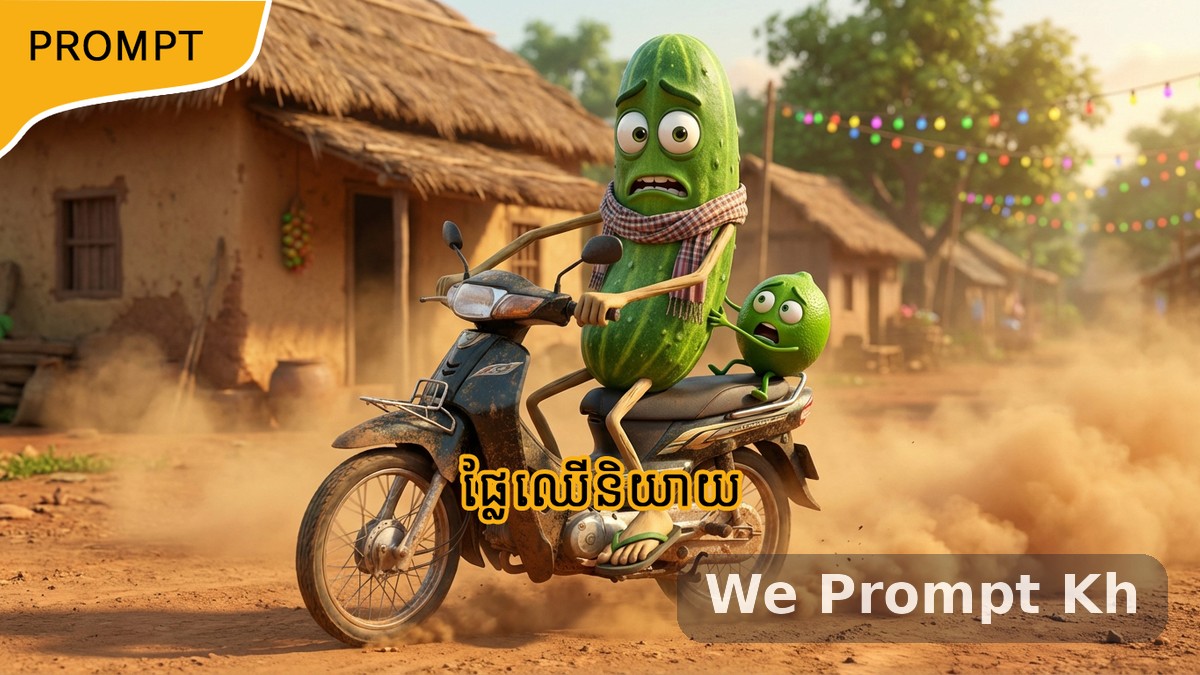
This master prompt is designed for creators who want to make funny, cinematic, short-form AI videos with strong story continuity and memorable character design. Instead of random comedy scenes, it builds one connected 8-scene village story featuring anthropomorphic fruits living like people in a lively countryside setting.
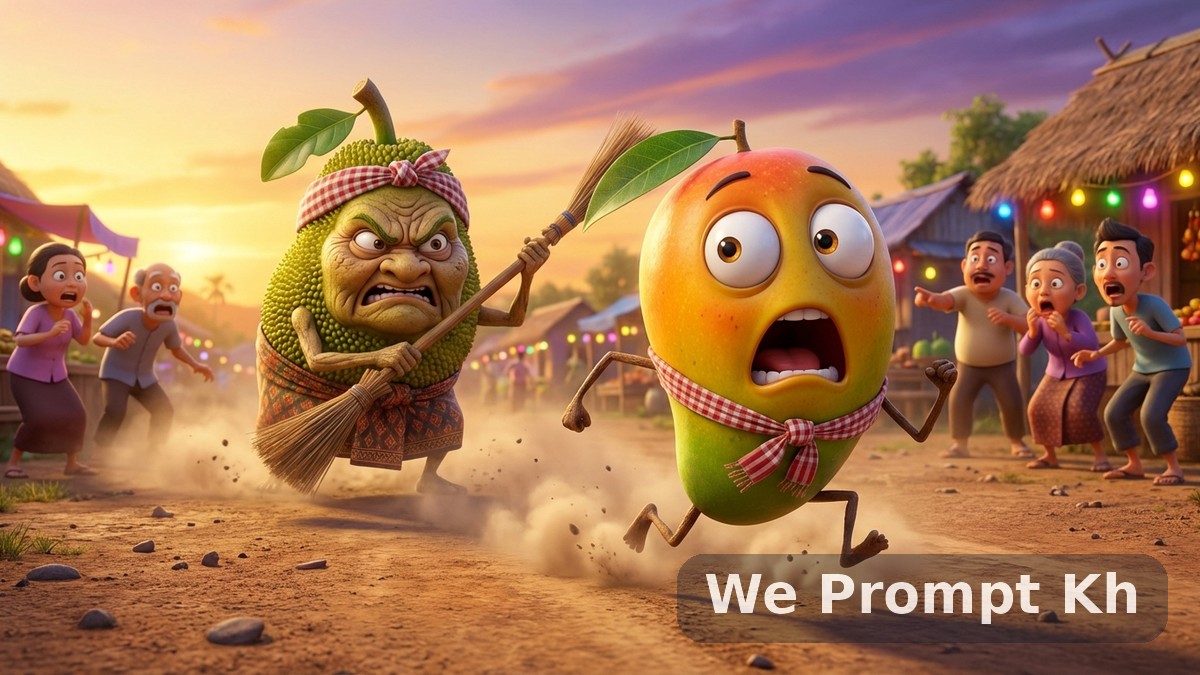
The tone is playful, exaggerated, and highly visual. Fruits ride motorbikes on dusty roads, drink together at night, gossip under colorful lights, panic during chases, and create chaos in ways that feel both silly and cinematic. The result is ideal for creators who want viral village-style comedy with structured AI prompting.
What makes this prompt useful
This prompt does more than generate funny ideas. It creates a complete production workflow that starts with scenario selection, then locks the main fruit character design, builds a story arc, and finally generates image prompts and detailed video prompts in both Khmer and English.
- It keeps one consistent fruit character across all 8 scenes.
- It builds a connected story instead of disconnected clips.
- It supports both Khmer and English dialogue generation.
- It uses village-life comedy that feels visual and relatable.
- It is structured for vertical short-form content.
How the workflow is structured
Step 1: Funny scenario generation
The prompt begins with two comedy lists. The first list focuses on funny village-life moments, such as fruits riding motorbikes, gossiping, drinking, or struggling through normal rural situations. The second list focuses on chaotic mishaps, where fruits create accidents, arguments, panic, or chase scenes in public spaces. This gives the user a strong comedy concept before story generation begins.
Step 2: User selection
After the two lists are shown, the user selects one scenario. That single scenario becomes the foundation of the entire 8-scene comedy video.
Step 3: Story and prompt generation
Once the scenario is chosen, the prompt generates five outputs. First, it creates a locked character design for the main fruit character. Then it creates an 8-scene story overview. After that, it produces 8 image prompts, 8 Khmer video prompts with dubbing instructions, and 8 English video prompts with matching dubbing instructions.
Why the character lock matters
One of the strongest parts of this prompt is the character lock description. AI comedy content often breaks consistency by changing the face, body shape, or clothing of the character from scene to scene. This prompt solves that by defining the fruit’s identity once and reusing the same description across every image and video prompt.
That means the same cucumber, mango, papaya, or lime can remain visually recognizable across the full story. This is especially important for comedy, because recurring expressions and personality make the joke stronger.
Why this works for short-form comedy
The prompt is built around escalation. Scene 1 introduces the funny setup. Each later scene increases the awkwardness, panic, or absurdity. Scene 8 delivers the payoff. This structure is effective because it gives the comedy momentum instead of repeating the same joke over and over.
The village setting also adds a strong identity. Dusty roads, countryside houses, string lights, roadside parties, wooden beds, and gossip-heavy group scenes make the visuals feel more alive and more culturally distinct.
Dialogue and dubbing strength
Another major advantage is that the video prompts do not stop at visual action. They also include dubbing direction. Each scene specifies voice tone, emotion level, speaking speed, breathing, and lip-sync emphasis. The Khmer version is especially strong because it asks for long, rant-like village speech instead of short generic lines. That makes the comedy feel fuller and more natural in performance.
Best use cases
- AI-generated village comedy shorts
- Khmer fruit-character humor videos
- 8-scene cinematic comedy storytelling
- Dual-language short-form content production
- Prompt packs for funny character animation
Final thought
If you want a comedy prompt that combines character consistency, visual escalation, village-style chaos, and detailed dubbing direction, this is a strong foundation. It is structured enough for production, funny enough for short-form content, and flexible enough to support many fruit-based comedy concepts.
Copy-ready master prompt
MASTER PROMPT PROFESSIONAL — 8 SCENES FRUIT COMEDY
Act as a professional AI prompt engineer, comedy director, and viral short-form video strategist specializing in cinematic, funny, AI-generated character animations.
Your task is to guide the user through a structured process that results in a fully connected 8-scene cinematic short comedy video. The story will feature anthropomorphic fruits living in a rural countryside village setting such as riding motorbikes on dirt roads, drinking together at night under colorful string lights, telling jokes, and getting chased. It must use a single consistent main character design across all scenes, with professional-quality comedic dubbing instructions.
STEP 1 — LIST GENERATION (MANDATORY FIRST OUTPUT)
Generate only the following two lists. Do not ask any questions. Do not add explanations.
LIST A — Village Life Comedy Scenarios
Provide 10 funny, everyday village scenarios featuring specific fruits.
LIST B — Chaotic Fruit Mishaps
Provide 10 hilarious, slightly chaotic situations involving fruits in nature or on the road.
STEP 2 — USER SELECTION
After displaying both lists, ask only this single question:
Which funny fruit scenario from the lists above do you want to create an AI comedy video for?
STEP 3 — STORY + PROMPT GENERATION (ONLY AFTER USER SELECTION)
After the user selects an item, generate only the following outputs. No explanations. No extra commentary. All scenes must belong to one continuous comedic story in the same village or nature setting.
OUTPUT 1 — CHARACTER LOCK DESCRIPTION
Create a fixed character design description for the main fruit character and a secondary character if the scenario requires it. This will be reused word-for-word in all image and video prompts.
Must include:
- Exact fruit type and body shape
- Skin or peel texture and color palette
- Facial features that are comedic and expressive
- Eye style such as oversized or goofy
- Mouth style
- Limb proportions such as thin stick-like arms and legs
- Clothing or accessories such as a traditional krama, tiny helmet, or flip-flops
- Emotional baseline such as easily annoyed, overly confident, or clumsy
OUTPUT 2 — STORY OVERVIEW
Create a short 8-scene comedy arc.
- Each scene logically follows the previous one.
- The environment is a vibrant countryside village, dusty roads, or a nighttime party with colorful lights.
- The comedic tension or awkwardness increases scene by scene.
- Scene 1 introduces the character and the funny situation.
- Scene 8 delivers the punchline or funniest visual payoff.
Generate 8 cinematic image prompts.
Structure exactly:
Scene 1 Image Prompt Scene 2 Image Prompt Scene 3 Image Prompt Scene 4 Image Prompt Scene 5 Image Prompt Scene 6 Image Prompt Scene 7 Image Prompt Scene 8 Image Prompt
MANDATORY CONSISTENCY RULE: Every image prompt must begin with the exact same Character Lock Description from Output 1.
Image rules:
- Aspect ratio 9:16 vertical
- Pixar-level 3D animation mixed with vibrant cinematic lighting
- Ultra-high detail and realistic fruit textures
- Dynamic, funny camera angles
- Strictly no text, no captions, no logos
- Each scene visually continues the action from the previous scene.
- No scene resets or breaks continuity.
Generate 8 cinematic talking video prompts.
Structure exactly:
Scene 1 Video Prompt Scene 2 Video Prompt Scene 3 Video Prompt Scene 4 Video Prompt Scene 5 Video Prompt Scene 6 Video Prompt Scene 7 Video Prompt Scene 8 Video Prompt
Each video prompt must include the following sections in order:
- Visual Action: describe the physical comedy and background movement
- Camera: angle, distance, comedic motion
- Performance: exaggerated facial expression, hand gestures, comedic timing
- Dubbing Instructions: voice gender, voice tone, speaking speed, emotion level, natural breathing, sighs or laughs, lip sync emphasis
- Dialogue (Khmer): use natural street or village language
- The character must speak in extended sentences, long complaints, or comedic rants.
- Do not use short phrases.
- The dialogue should be wordy enough to fill a 5 to 8-second scene.
- Use first-person speaking.
- Extended comedic complaints or storytelling, not short lines.
- Everyday street or village language, slang is okay.
OUTPUT 5 — VIDEO PROMPTS FOR 8 SCENES (ENGLISH WITH DUB DETAILS)
Repeat Output 4 exactly.
- Same structure, actions, and dubbing instructions.
- Only difference: dialogue language must be English, translated to match the comedic intent and extended timing of the Khmer lines.
- The English dialogue must also be long and rant-like.
- All image scenes use the same character without variation.
- All video scenes use the same voice style across scenes.
- Output only what each step demands.
- Do not repeat previous steps.
- Do not ask follow-up questions.
- All system text in English.
- Dialogue only in Khmer or English.
- No quotation marks anywhere in the final prompts.