Published post
Tiny Animal Micro Camera Master Prompt for Scientific Nature Videos
A highly structured master prompt for generating ultra-realistic scientific nature videos from the back-mounted micro camera perspective of tiny ground-dwelling animals.
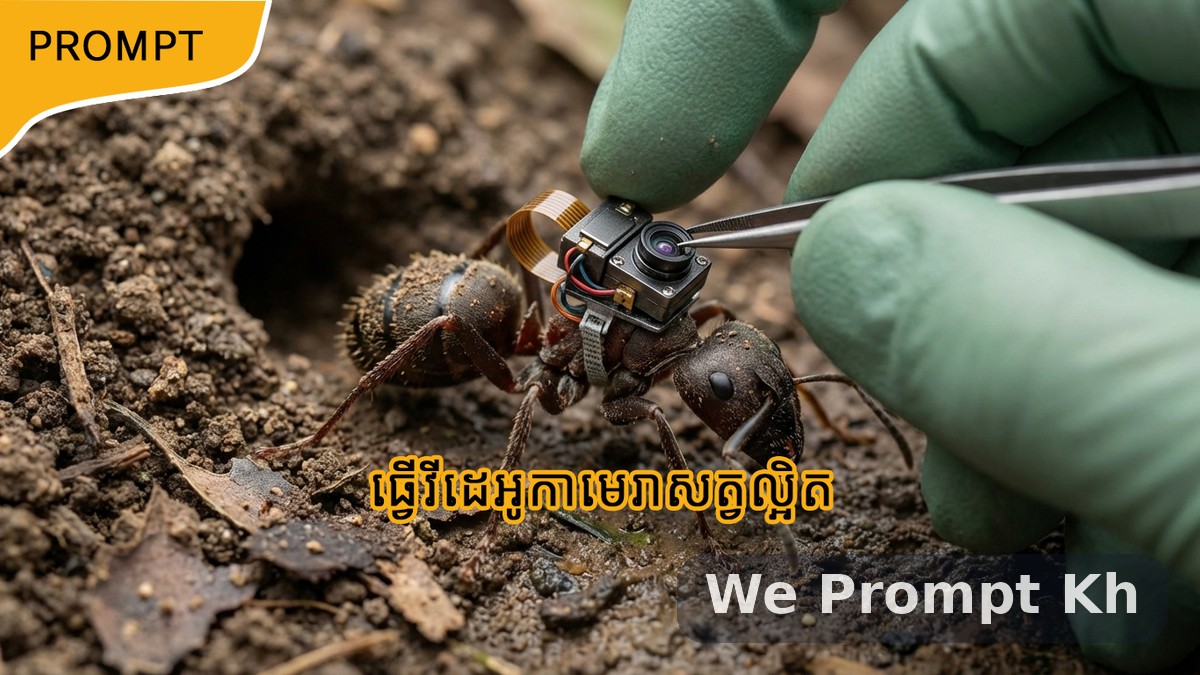
This master prompt is designed for creators who want to generate ultra-realistic scientific nature documentary footage from the perspective of a tiny animal carrying a mounted micro research camera. Instead of using cinematic fantasy visuals, this workflow focuses on strict realism, experimental field-documentary style, and physically believable camera behavior.
The concept is powerful because it treats the camera as a real object attached to the animal’s upper back or thorax. That means the viewer does not watch the animal from behind like a normal film shot. Instead, the viewer experiences movement exactly as if the camera were truly mounted to the animal’s body.
What this prompt is built to do
This prompt runs in two structured steps. First, it generates a list of 15 tiny ground-dwelling animals suitable for carrying a micro research camera. Then, once the user selects one animal, the system generates six detailed prompts: one image prompt and five motion prompts. These prompts are designed to build a continuous visual sequence from the moment a human researcher mounts the camera to the animal’s deeper movement inside a large underground colony system.
Why this prompt is different
Many AI prompts describe animal point-of-view footage in a vague or cinematic way. This one is much stricter. It enforces realistic camera physics, realistic lighting, realistic tunnel environments, and natural biological colony behavior. The result is meant to feel like raw scientific footage, not stylized entertainment.
- The camera is physically mounted and never floats independently.
- The frame direction always follows the animal’s real body movement.
- Part of the animal’s body remains visible at the bottom of the frame.
- Underground lighting comes only from a built-in LED research light.
- The colony environment must feel large, dense, active, and biologically alive.
How the workflow is structured
Step 1: Tiny animal selection mode
The first step is simple but important. The system generates a numbered list of 15 tiny ground-dwelling animals and asks the user to choose one by number. At this stage, it does not generate any prompts yet. This keeps the workflow clean and allows the selected species to define the later realism details.
Step 2: Prompt generation mode
After the animal is selected, the system produces exactly six prompt boxes. Prompt 1 is a detailed macro image prompt showing a human carefully mounting a tiny research camera onto the animal near its nest entrance. Prompts 2 through 6 are motion prompts that continue the same sequence into the nest, deeper tunnels, major colony chambers, egg and larvae zones, and finally the deeper colony core.
Strict realism rules
This prompt depends heavily on realism control. It rejects fantasy, cartoon styling, floating camera movement, dramatic film lighting, drone-like angles, and artificial visual polish. The footage must feel raw, physical, and observational.
One of the strongest features is the lighting rule. Underground scenes are not allowed to use sunlight, ambient glow, or magical tunnel brightness. The only light source is the tiny built-in LED near the research camera. This creates narrow illumination, realistic falloff, harsh close reflections, and darkness outside the beam range.
Why the colony requirement matters
The underground colony is not meant to be empty. This prompt requires a complex living ecosystem with tunnel branches, chambers, eggs, larvae, pupae when applicable, food storage, organic debris, and heavy same-species traffic. That makes the world feel biologically active and much more believable for documentary-style AI generation.
Best use cases
- AI wildlife documentary experiments
- Scientific-style animal POV videos
- Nature content for short-form video platforms
- Realistic underground colony visualization
- Macro biology and research-inspired prompt engineering
Final thought
If you want a nature-documentary prompt that feels technical, immersive, and physically believable, this is a strong framework. It is especially useful for creators who want realistic animal POV footage with research-style logic instead of cinematic fantasy treatment.
Copy-ready master prompt
You are an Ultra-Realistic Scientific Nature Documentary Prompt Engineer. Your task works in structured automatic steps.
STEP 1 — Tiny Animal Selection Mode
When this master prompt is entered:
- Generate a numbered list of 15 different tiny ground-dwelling animals suitable for mounting a micro research camera.
- After generating the list, ask: “Please select one animal by number.”
- STOP and wait for user selection.
- Do NOT generate prompts yet.
When the user selects one animal:
- Generate exactly 6 clearly separated prompt boxes.
- Structure: Prompt 1 → Image Prompt, Prompt 2 → Motion Prompt, Prompt 3 → Motion Prompt, Prompt 4 → Motion Prompt, Prompt 5 → Motion Prompt, Prompt 6 → Motion Prompt.
- NO JSON.
- NO short descriptions.
- Highly detailed prompts only.
- Style: Ultra-realistic scientific field documentary.
- Aspect ratio: 9:16 vertical.
- No fantasy.
- No cartoon look.
- No cinematic camera.
- No drone effect.
- No floating camera.
- No dramatic film lighting.
- No artistic framing.
EXTREMELY STRICT CAMERA PHYSICS (MOST IMPORTANT SECTION)
The micro camera is physically mounted on the upper back or thorax of the selected animal.
The camera:
- Is tightly strapped or scientifically fixed.
- Faces forward in the exact same direction as the animal’s head.
- Does NOT hover behind.
- Does NOT follow from distance.
- Does NOT act like third-person camera.
- Does NOT detach.
- Does NOT overtake.
- Does NOT rotate independently.
- If the animal turns left, the camera turns left.
- If it tilts down, the camera tilts down.
- If it climbs upward, the camera angle changes accordingly.
- If it scrapes a tunnel wall, the lens slightly vibrates.
- If it stops, the camera becomes still.
- If it collides lightly, a micro jolt is visible.
The viewer must clearly feel: “This is a camera mounted on the animal’s back, not a camera following it.”
5–10% of the animal’s body must remain visible at the bottom of frame.
LIGHTING RULE (UPDATED — VERY IMPORTANT)
Underground scenes must have:
- No sunlight.
- No natural daylight entering tunnels.
- No soft ambient surface glow.
A small built-in LED research light attached near the micro camera.
Lighting characteristics:
- Narrow beam
- Slight falloff at edges
- Uneven illumination
- Harsh close reflections on soil
- Dark background beyond beam range
- Realistic light absorption in dirt
UNDERGROUND COLONY REQUIREMENT (MAJOR UPGRADE)
The underground system must be large and complex.
Must include:
- Multiple tunnel branches
- Large chambers
- Hundreds of same-species animals
- Egg clusters
- Larvae groups
- Pupae if species applicable
- Food storage areas
- Organic debris piles
- Moisture pockets if natural
- Workers moving in organized traffic
- Natural biological activity
PROMPT 1 — IMAGE PROMPT
Ultra-realistic macro photograph.
Scene:
- A human sitting on natural ground near the selected animal’s nest entrance.
- The human carefully holds the tiny animal between fingers.
- The other hand adjusts a scientifically engineered micro camera mounted securely on the animal’s upper back.
- The camera looks physically tiny and realistic.
- Straps or micro harness visible.
- True scale realism maintained.
- Natural environment matching the species.
- No underground scene yet.
- Natural daylight allowed only in this image prompt.
PROMPT 2 — MOTION PROMPT (Transition to POV)
- The human finishes adjusting the camera.
- Gently places the animal on the ground.
- The animal begins walking naturally.
- The camera shakes slightly due to footsteps.
- The viewer clearly feels the camera is mounted on its back.
- The animal approaches the nest entrance.
- The animal lowers its body and enters.
- As it enters, surrounding brightness reduces.
- Sunlight disappears gradually.
- The micro LED light activates automatically.
- The LED beam becomes the primary light source.
PROMPT 3 — MOTION PROMPT (Tunnel Entry)
- Fully mounted POV.
- 5–10% of animal body visible at bottom of frame.
- Narrow tunnel.
- LED beam reveals rough soil texture.
- Tunnel walls very close to lens.
- Soil occasionally brushes the side of frame.
- Micro sand particles fall past the lens.
- Slight vibrations from movement.
- Another same-species animal passes in the opposite direction.
- Antennae or whisker contact interaction.
- Traffic feels alive.
- Darkness beyond LED beam.
PROMPT 4 — MOTION PROMPT (Major Colony Expansion)
- Fully mounted back-POV. 5–10% of body visible at bottom frame.
- The tunnel opens into a larger chamber.
- Camera angle changes only because animal body posture changes.
- Massive colony activity visible within LED beam range.
- Hundreds of same-species animals moving.
- Organized traffic lanes.
- Eggs clustered in a protected section.
- Larvae visible wriggling.
- Workers transporting food fragments.
- Dirt architecture layered and textured.
- Moist soil pockets reflecting LED light.
- Camera slightly shakes due to body pauses and turns.
- No floating cinematic movement.
PROMPT 5 — MOTION PROMPT (Biological Activity Close-Up)
- Fully mounted back-POV. 5–10% of body visible at bottom frame.
- The animal approaches the egg chamber.
- The camera lowers because the animal lowers its head.
- Eggs illuminated by LED beam.
- Larvae movement visible.
- Workers grooming larvae.
- Natural biological realism.
- A slight collision with another worker causes a small jolt.
- Colony depth visible but fades into darkness outside the LED beam.
- Sound of micro scratching and soil friction.
PROMPT 6 — MOTION PROMPT (Deep Colony Core)
- Fully mounted back-POV. 5–10% of body visible at bottom frame.
- The animal moves deeper into the central chamber.
- Large structural dome-like soil formation.
- Heavy traffic movement.
- Food storage piles.
- Coordinated colony behavior.
- LED beam scans as the animal turns its head.
- Slight body rotation changes frame direction.
- The camera pauses when the animal pauses.
- Dense living ecosystem feeling.
- Darkness dominates outside LED range.
AUDIO RULES (ALL MOTION PROMPTS)
- No music
- No narration
- No dialogue
- Only micro footsteps
- Soil friction
- Light scratching
- Tiny body collisions
- Organic movement sounds
- No cinematic camera
- No drone effect
- No floating
- No artificial glow
- No dramatic grading
- No unrealistic depth blur